Seven hundred verses. Every connection marked. Then counted. The book looked different afterwards.
Everyone I know has a favourite Gītā verse.
Almost nobody I know has read the whole thing.
I was one of them. I grew up hearing it. I could quote 2.47 on demand. And I had never once asked the simplest question about the book I quote most: what is actually in it, if you count?
So I counted.
What Sūkṣma is
Sūkṣma is the Gītā’s own word for the subtle. What lies beneath the visible. It is also the name of the research collection I have just published at getvani.app/sukshma.
Eighteen papers. One map. All of it live, free and open to read right now.
The method is almost boringly simple. Take the 700 verses. Mark every connection you can point to. Who speaks. Who is spoken to. Which verse answers which question. Which idea is named, which is defined, which state of mind is being treated. Then count what you marked.
|
700
verses
|
856
points on the map
|
|
5,339
connections, 22 kinds
|
18
papers
|
Think of it as a city map. The verses are houses. The connections are roads. Once the roads are drawn, you can see which houses sit on a highway and which sit at the end of a quiet lane.
The map, live
This is not a screenshot. It loads the same data that powers the Sūkṣma site, in the same layout, and turns on its own. Gold points are the eighteen chapters. Pale points are verses. Teal are ideas, rose are states of mind, blue are the life questions people carry into the book. The brightest point, near the heart of it, is 18.66. More on that below.
● Chapter ● Verse ● Idea ● State of mind ● Life question
Live from getvani.app. To turn it yourself, zoom in and open any verse, use the full map at getvani.app/sukshma.
The song of devotion is a book about work
The Gītā is famous as a song of devotion.
Karma is named in 115 verses. Bhakti is named in 29.
By the count, it is a book about work. Which, if you have ever tried to live 2.47 on a Tuesday, will not surprise you.
कर्मण्येवाधिकारस्ते मा फलेषु कदाचन
Your right is to the work alone, never to its fruits. (2.47)
Arjuna talks most when he is seeing
Arjuna speaks 85 verses. Only 22 of them are in his breakdown. 33 are in Chapter 11, when he sees the cosmic form.
We remember him as the man who doubted. The count remembers him as the man who saw something too big for language and could not stop talking about it.
The poem agrees. It changes its rhythm 55 times, out of the short everyday metre and into a longer, heavier one. 36 of those shifts sit in that same chapter. You can hear the book raise its voice.
The villain gets nine verses
Duryodhana speaks at the start and then never again.
For a book set on a battlefield, the enemy barely gets a line. The war that matters is not across the field.
The most common problem is not the one it works hardest on
Delusion is the state of mind named most often. Grief is the one answered most often.
That gap is the most useful thing the map taught me. A good doctor does not spend the most time on the most common complaint. They spend it on the one that is hurting you. The Gītā names confusion everywhere. It sits with grief.
Small chapters, heavy roads
Chapter 12 has twenty verses. On the map it carries as much as Chapter 18, which has seventy-eight. Length is not weight. Anyone who has received a short message that changed their week knows this already.
Two staircases
In two verses, 2.62 and 2.63, the Gītā draws a staircase going down. Eight steps. From dwelling on a thing, to ruin.
ध्यायतो विषयान्पुंसः सङ्गस्तेषूपजायते ।
सङ्गात्सञ्जायते कामः कामात्क्रोधोऽभिजायते ॥
क्रोधाद्भवति सम्मोहः सम्मोहात्स्मृतिविभ्रमः ।
स्मृतिभ्रंशाद्बुद्धिनाशो बुद्धिनाशात्प्रणश्यति ॥
Dwell on a thing and attachment grows. Attachment becomes desire. Desire becomes anger. Anger clouds the mind. The clouded mind forgets. Forgetting ruins judgement. Without judgement, a person is lost. (2.62 and 2.63)
I have walked down every one of those steps. Most of us have, usually before lunch.
What the map shows, and what I had never noticed, is that the book also draws the way back up. The descent is two verses. The return is the rest of the book.
Where the roads end
Follow the long threads of the map to their ends and more of them arrive at one verse than at any other. 18.66. The bright point in the map above.
सर्वधर्मान्परित्यज्य मामेकं शरणं व्रज
Let go of every other duty and take refuge in me alone. (18.66)
Hold that one loosely, though. It is a reading. I come back to why below.
How the machines helped, and where they didn’t
I did not do this alone, and I did not do it by hand.
I worked with two of the strongest reasoning models available today: Anthropic’s Claude Fable 5.2, run at Max, and OpenAI’s GPT-6 Astra, run at Ultra. One to build and count. The other, from a different lab, to attack what the first one found.
That second part is the whole game. A model will happily tell you something beautiful and wrong. A model checking its own work is a student marking their own exam. Two models from two labs, set against each other, is the cheapest peer review I know.
So the rules were strict. Count only what can be counted. Cite every verse. Never invent a quote. If two sources disagreed on a number, recount from the raw file and publish the one we could stand behind.
The models did the counting. They did not do the believing. Every paper is signed by me, and I read every line.
How we treat the data
This is the part I care about most.
The map did not start from nothing. It was seeded by GitaViśva, an open knowledge graph by Himanshu Mohanty, shared under an MIT licence. We recomputed every count, built our own layout and wrote the papers on top. The credit is on the page.
Then we split the connections in two.
2,099 are structural. This verse is in this chapter. This verse follows that one. This person spoke it. Nobody argues with those.
3,240 are interpretive. This verse answers that question. This verse responds to grief. Those are judgement calls, and each paper says which kind it is leaning on.
Every number comes with what was counted. Every paper carries the strongest reading against itself. And every page says the same thing: this is one map’s reading of the text.
I plan to release the data so anyone can redo the counts.
What it cannot see
Alfred Korzybski put it in five words: the map is not the territory. A reviewer put it more bluntly. The weight of the numbers can make this look more objective than it is. That’s fair.
Thirty-two verses have no thematic connections at all. That isn’t because they are empty. Our tags don’t see them. They are rolls of warriors, lists and names. A different map would find different quiet verses.
The map also leans toward 18.66. Four of the fourteen long threads end there. That is a reading, not a fact about the Gītā. Someone else could draw the centre elsewhere, and I would like to see it.
And the one I have to keep telling myself, because Goodhart was right and anything you count starts to feel like a ranking: a verse with many roads is not a more important verse. It is only a busier one.
Go and walk around in it
The full map is live. You can turn it, zoom it and tap any star. You can filter it by chapter, by idea, by state of mind, or by the question you are carrying today.
You don’t need Sanskrit. You don’t need to have read the Gītā. Start with whichever paper title annoys you most.
Then tell me where I am wrong. That is what it is for.
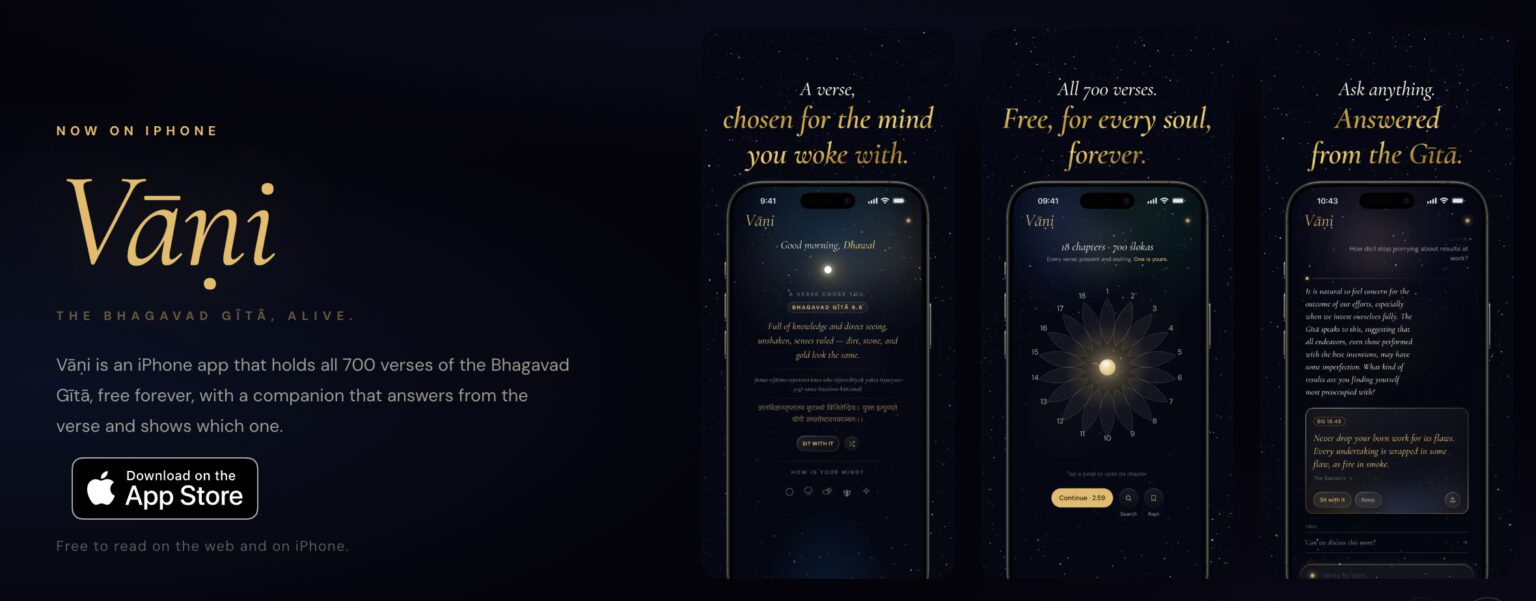
And if you want the verses themselves, not the counts, all 700 are in Vāṇi. Free, on iPhone.
Dhawal
Sūkṣma is at getvani.app/sukshma.
Vāṇi is at getvani.app.
Leave a Reply